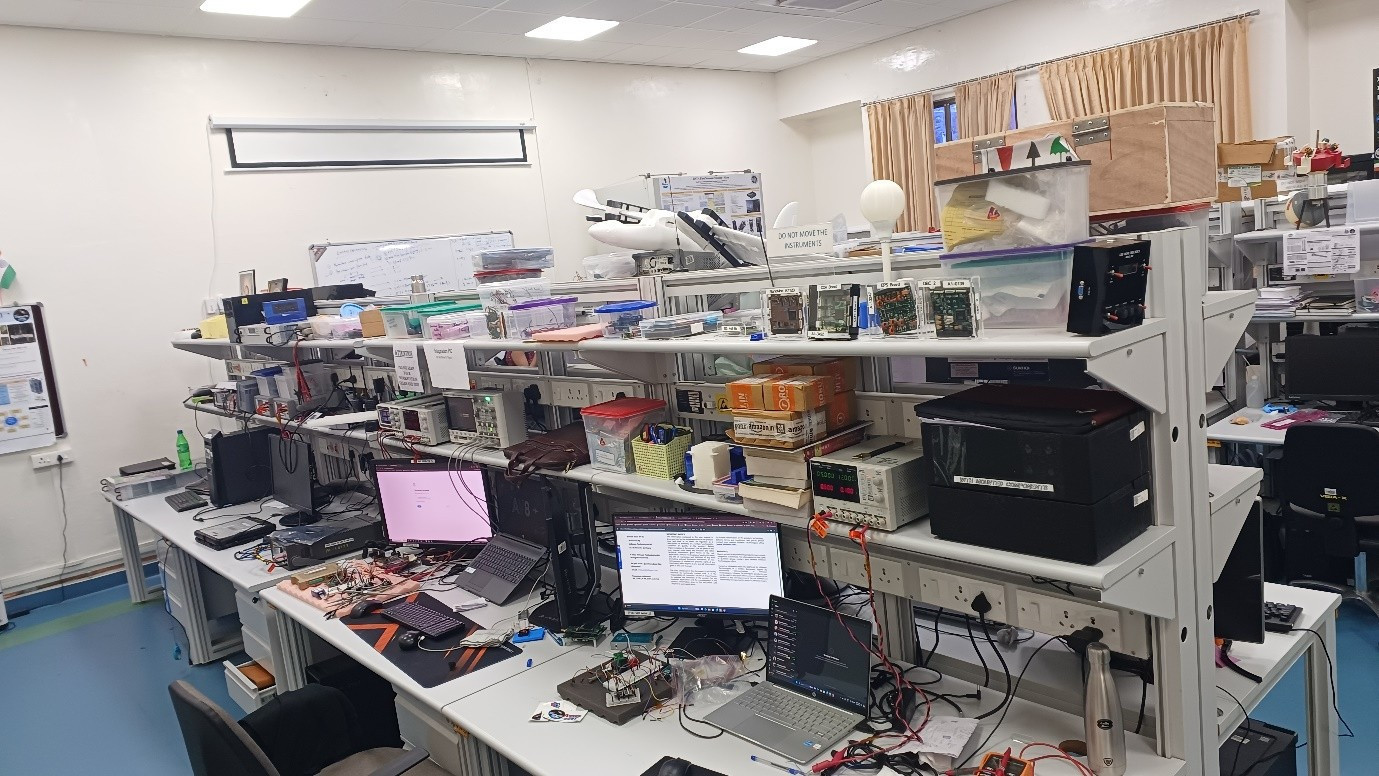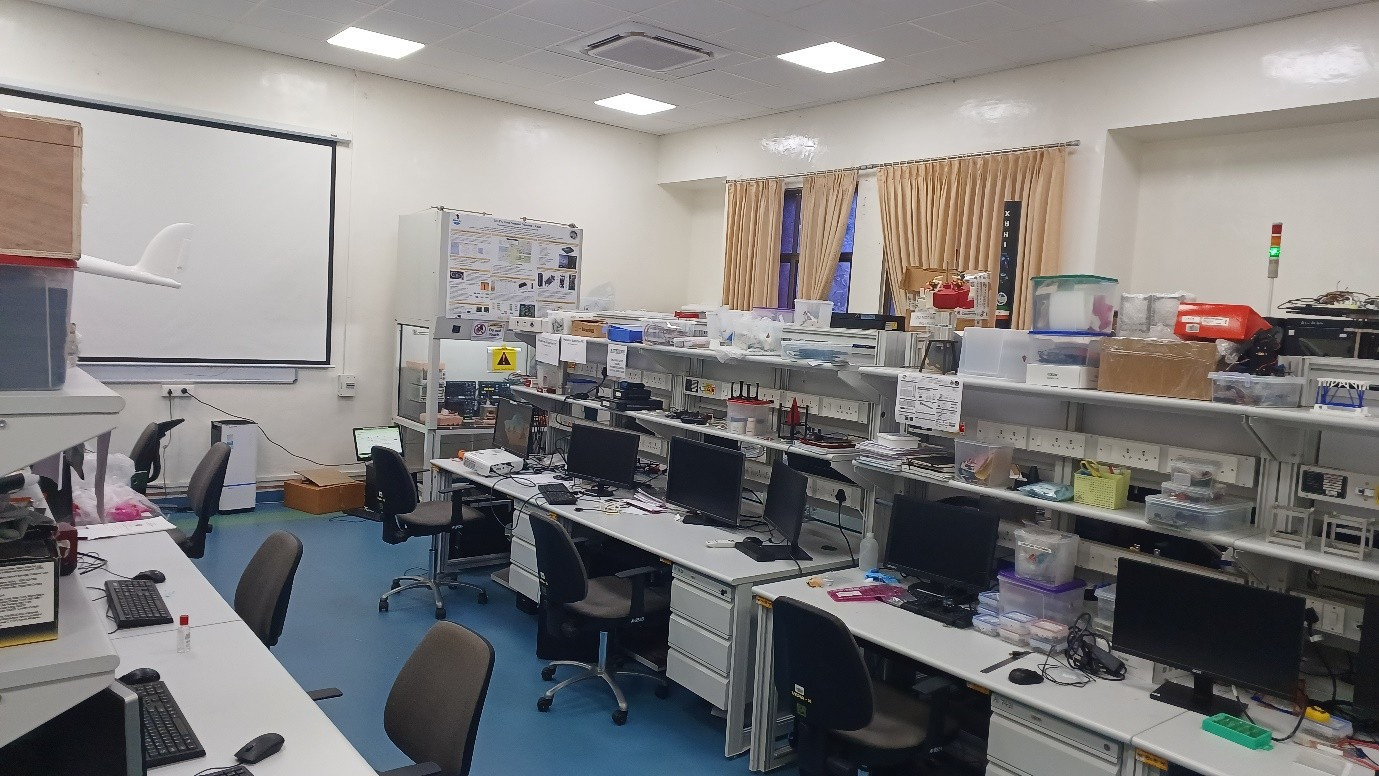

Small Spacecraft Systems & Payload Centre (Electronics Fabrication & Research Lab)
SSPACE (Small-Spacecraft Systems and Payload Center) is a state-of-the-art, student-driven organization under the guidance of faculty members from multiple departments of the institute. It is actively involved in developing spacecraft systems for small satellites and science payloads. From indigenously developing subsystems for small satellites, including On-board Computer Systems, Electrical Power Systems, Communication Systems, Attitude Determination and Control Systems, and Structures, SSPACE now focuses on developing science payloads in various domains such as Astrobiology, Remote Sensing, and Navigation. SSPACE is also engaged in other fields, including drones, sounding rockets, and docking systems.
One of the upcoming missions is GRACE (GMC Reprogramming and Communication Experiment), a science payload that will soon be launched aboard the PSLV-POEM platform. Past missions include PILOT, launched on PSLV C55 in April 2023, which focused on validating thermal models of subsystems in Low Earth Orbit (LEO). This mission also marked a milestone with 3D-printed structures, developed in collaboration with L&T, being flown in space for the first time. Another notable mission, INSPIRESAT-1, successfully launched aboard PSLV C52 on February 14, 2022, was a student-built satellite developed in collaboration with international partners, including LASP (USA), NCU (Taiwan), and NTU (Singapore). INSPIRESAT-1 operated well beyond its expected mission life of six months, gathering valuable scientific data for more than Two and Half Year. Continuing the INSPIRE series, INSPIRESAT-3, a 27U small satellite, is currently in development.
SSPACE Ground Station Facility
IIST has also established a Ground station, fully developed and supported by students and staff of IIST, with guidance from talented professors and experts from ISRO centres. The IIST ground station currently houses UHF, C-band, and S-band antennas for telemetry, tele command, and data reception from spacecraft. The ground station supports not only IIST payloads and satellites, such as INSPIRESAT and PILOT, but also provides ground station facilities to private entities for tracking and receiving data from their satellites.